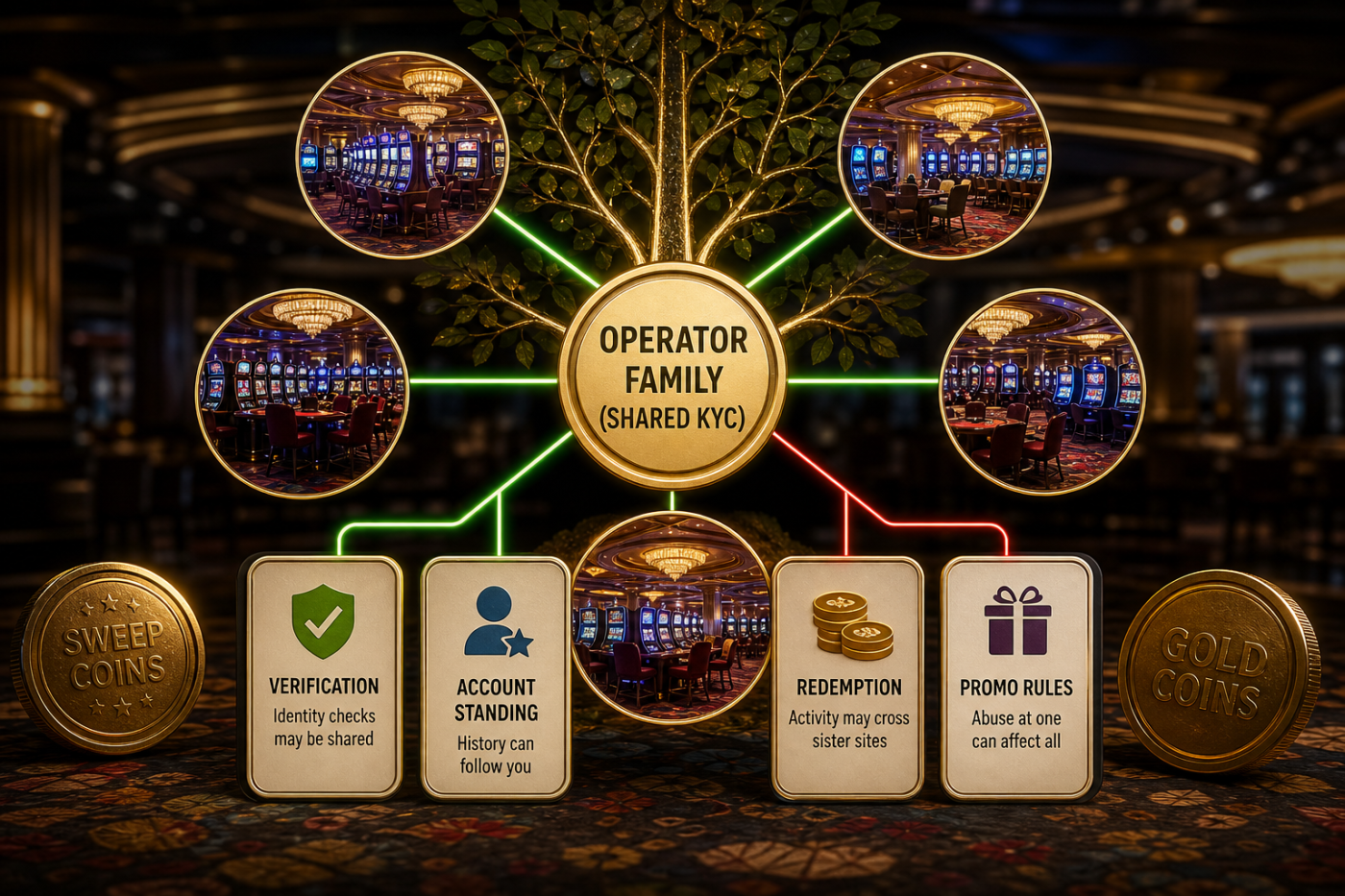
Short answer: Sister-site KYC means related sweepstakes casinos may share, recognize, or review parts of your identity verification, payment history, account standing, or risk profile across the same operator family. That can help with smoother identity checks, but it can also mean chargebacks, duplicate accounts, promo abuse, or bans may affect more than one site. Terms apply.
By Ethan Parker, Sweeps Flow Editorial | Updated August 2026
Some sweepstakes casinos feel like totally separate places. Different colors, different lobbies, different vibes. But behind the curtain, a few may share the same parent company, platform, or account rules. That is where sister-site KYC starts mattering.
The terms are doing the most, but your account reputation still has to live there.
This Red Flag Radar guide explains what may travel between related sites, what you should check before signing up, and how to avoid accidentally treating one operator family like five unrelated accounts.
Quick Take: Sister-Site KYC in Plain English
- Sister sites are casinos connected by the same parent company, operating entity, platform, or related business group.
- KYC means Know Your Customer, the identity check many sites use before certain account actions or redemption.
- Your verification status may be recognized across related sites, but this is not guaranteed. Check current terms.
- Your account standing, including bans, chargebacks, duplicate-account issues, or terms breaches, may also affect related sites.
- Before joining a new casino, check the operating entity in the terms. A “new” site may be another door into the same house.
What Is Sister-Site KYC?
Sister-site KYC is when related sweepstakes casino brands use shared or connected identity, risk, fraud, or account-review systems. In real-player terms, one site may know something about your account history from another site in the same family.
KYC usually asks you to prove you are who you say you are. Depending on the site, this can include identity details, address checks, document review, or other verification steps. Do not assume the same process applies everywhere. Always read the current terms and verification page before you play toward redemption.
Here is the protective part: shared systems can help honest players, but they can also carry problems forward. If one account has a serious issue, the related accounts may not get a clean slate.
Why Sister-Site KYC Matters Before You Sign Up
Most players only think about KYC when a redemption gets delayed. Fair. That is usually when the fine print starts tapping the mic.
But sister-site KYC matters earlier, before you create another account, claim another welcome offer, or use a different email because “it is a different casino.” If the operator treats related brands as one account family, your choices at one site may affect the others.
| What may connect across sister sites | Why it matters | What to check |
|---|---|---|
| Identity verification | A completed KYC review at one brand may speed up or inform review at another related brand. | Verification terms, privacy policy, account rules |
| Account standing | A suspension, ban, fraud review, or serious terms issue may affect related accounts. | Terms about account closure, restricted users, and linked accounts |
| Chargeback history | A disputed purchase may trigger wider account review within an operator family. | Purchase terms, chargeback policy, user agreement |
| One-per-household rules | Promo eligibility may be limited by household, person, device, payment method, or related account. | Promotion rules and welcome-offer terms |
| Duplicate-account signals | Using different emails or details can look suspicious if the system connects the accounts. | Multiple-account policy and identity rules |
Which Sweepstakes Casinos May Be Sister Sites?
Examples of sweepstakes casino families to verify before signup
Some sweepstakes casino brands are publicly connected through the same parent company, operating entity, or platform operator. The examples below are starting points, not a guarantee that every account rule is shared across every brand. Always check the current terms, privacy policy, sweepstakes rules, and operating entity before signing up.
VGW family: VGW’s own terms hub lists Chumba Casino, LuckyLand Slots, LuckyLand Casino, and Global Poker under its brand and policy pages. As of August 2026, LuckyLand Slots has an official closure notice stating it will permanently close on September 14, 2026, so the family tree should mark that brand as “winding down” rather than treating it like a normal active signup option.
B-Two / B2 Services example: HelloMillions.com states that it is owned and operated by B-Two Operations Limited, and that B2 Services OÜ is its payment services agent. If another brand shows the same operating entity or payment-services agent in its current terms, footer, privacy policy, or support pages, treat it as potentially related until verified.
Gold Coin Group example: Chanced’s terms state that Chanced is owned and operated by Gold Coin Group LLC. Punt.com’s terms state that Punt.com is also owned and operated by Gold Coin Group LLC. That makes the Chanced/Punt.com relationship worth checking before treating the accounts as unrelated.
Reader rule: brand names are not enough. The operating entity in the footer and terms is the receipt.
What Can Travel Between Sister Sites?
Think of sister sites like connected doors in the same building. The lobby may look different, but the security desk may be using the same company name, verification vendor, payment agent, fraud rules, or account-review playbook. Not every family shares every signal, so the receipt is always in the current terms.
1. Verification status
If you already completed KYC with one brand, a related brand may recognize some of that information. That does not mean you can skip every step. It means your earlier verification may be part of the review.
Protective takeaway: Use the same truthful legal name, date of birth, address, and account details. Do not try to “start fresh” with mismatched information. That can create problems later, especially around redemption.
2. Account standing
If there is a ban, chargeback, document mismatch, duplicate-account issue, self-exclusion, or terms breach, a related brand may review that history before approving your account, offer eligibility, or redemption.
Protective takeaway: Treat each operator family like one long-term relationship. If something goes wrong, document it, contact support, and avoid opening new related accounts while the issue is unresolved.
3. Promotion eligibility
Some promotions have limits tied to one person, household, email, payment method, device, address, or related account. A sister site may not count you as a totally new player for every offer.
Protective takeaway: Before claiming a welcome offer, read the promo terms. Look for phrases like “one per person,” “one per household,” “related accounts,” “affiliated brands,” or “in our sole discretion.” Terms apply.
4. Chargeback history
Chargebacks are serious. If you dispute a purchase through your bank instead of working with support first, an operator may restrict your account. Related sites may also review your standing.
Protective takeaway: If you have a billing issue, save screenshots, order IDs, emails, and support tickets. Start with the operator’s official support process when it is safe and appropriate, and keep all records. If you later need to involve your bank or payment provider, you will have a clearer paper trail. For more context, read Sweeps Flow’s chargeback walkthrough before disputing a purchase.
What should you check in the privacy policy?
KYC is not only an account rule. It is also a data issue. Before you sign up with a related brand, open the privacy policy and search for phrases like “affiliates,” “group companies,” “service providers,” “fraud prevention,” “identity verification,” “payment processing,” and “business transfers.” Those phrases can show who may process or receive your account, payment, and verification information.
Protective takeaway: do not upload ID documents, bank details, or address proof until you are on the official site and understand who is collecting the information.
The 30-Second Sister-Site KYC Check
Before you sign up for another sweepstakes casino, do this quick check. It is not fancy, but it saves drama.
- Open the site footer. Look for Terms of Use, Sweepstakes Rules, Privacy Policy, or About pages.
- Find the operating entity. Search the page for “operated by,” “sponsor,” “owner,” “company,” “payment agent,” and “affiliate.” Write down the exact legal name, not just the casino brand.
- Compare it to casinos you already use. If the same entity appears, treat the new site as related until proven otherwise.
- Search the terms for key phrases. Try “related,” “affiliate,” “household,” “duplicate,” “chargeback,” “verification,” and “account closure.”
- Check promo rules separately. A site’s general terms and bonus terms may both matter.
Sister-Site KYC Checklist Before You Create an Account
Use this before you register anywhere new, especially if you already play at another casino that may be connected.
- I checked the operating entity in the terms.
- I checked whether the site mentions affiliated brands or related accounts.
- I used my real, consistent identity details.
- I did not create a second account to bypass limits, bans, or promo rules.
- I read the welcome-offer terms before claiming anything.
- I checked state restrictions and age requirements on the current site.
- I understand that no purchase is necessary for sweepstakes-style promotions, and I checked the site’s Alternative Method of Entry (AMOE) rules if available.
- I am playing for entertainment, not income, and I set a limit before purchasing Gold Coins or playing with Sweeps Coins.

Example: How One Issue Can Spread Across Related Sites
Let’s say a player joins Casino A, completes KYC, and later has a billing dispute. Instead of contacting support, they file a chargeback. Their Casino A account is restricted.
Then they sign up for Casino B, which looks unrelated but shares a parent or platform with Casino A. During verification or account review, Casino B may see the prior issue and restrict the new account too.
This is where the math starts acting suspicious.
The point is not that every operator handles this the same way. The point is that related sites may not treat your history as separate. If there is a dispute, handle it carefully, keep receipts, and do not assume a new logo means a new relationship.
What To Do If Your KYC or Account Standing Is Shared
- Stay consistent. Use accurate information across accounts. Mismatched details can slow or block verification.
- Ask support directly. If you are unsure whether accounts are connected, ask whether the brands share account review or verification systems.
- Do not open extra accounts to fix a problem. That can make the original issue worse.
- Save your records. Keep screenshots of terms, promo pages, purchase receipts, redemption requests, and support replies.
- Pause play during disputes. If your account is under review, avoid adding more activity until you understand the issue.
Responsible Play Note
Sweepstakes casinos are for entertainment. Do not treat Gold Coin purchases, Sweeps Coins play, or redemptions as income. Set a budget before you play, take breaks, and do not chase losses. If play stops feeling fun or starts affecting your money, mood, or relationships, step away and consider using support tools or outside help.
What To Do Next
- Make a list of the sweepstakes casinos where you already have accounts.
- Check each site’s operating entity and terms.
- Group related casinos together, like a family tree.
- Review any promo, KYC, or redemption rules that may apply across related accounts.
- If you are new, start with Sweeps Flow’s beginner resources before registering: create your Sweeps Flow account here.
Sweeps Flow Take
Sister-site KYC is not automatically bad. It can make verification smoother when your account is clean and your details match. But it also means your reputation may travel. One chargeback, duplicate account, or promo mistake may trigger wider account review across related brands.
Our bestie advice: before you join another sweeps casino, check the company behind it. If it shares a parent company, operating entity, platform, or account-review rules with a site you already use, treat it like the same house with different wallpaper. Keep your details honest, read the promo terms, and save your receipts.
Final word: Sister-site KYC is really about connection. If the sites are connected, your account history may be too. Read the terms, check the operator family, and keep your play clean and consistent.
FAQs About Sister-Site KYC
What does sister-site KYC mean?
Sister-site KYC means related casino brands may share or recognize identity verification, account review, or risk information. It can happen when sites share a parent company, operating entity, platform, or related account systems. Check each site’s current terms for the most accurate details.
Can being banned at one sweepstakes casino affect another?
It may. If two casinos share an operator, parent company, payment agent, platform, or account-review system, a ban or serious account issue at one site may be reviewed when you use another related site. Chargebacks, duplicate accounts, false information, self-exclusion, or terms breaches are the kinds of issues to treat seriously. Policies vary, so check the current terms.
Which sweepstakes casinos are owned by the same company?
Some relationships can be verified through current official terms and operator pages. VGW’s terms hub lists Chumba Casino, Global Poker, LuckyLand Casino, and LuckyLand Slots among its brand terms and sweepstakes-rules pages. HelloMillions.com identifies B-Two Operations Limited as its operator and B2 Services OÜ as its payment-services agent. Chanced and Punt.com both list Gold Coin Group LLC as their owner/operator in current terms. Because ownership, closures, and terms can change, always check the current footer, terms, privacy policy, and sweepstakes rules before signing up.
Can I claim welcome offers at sister sites?
Sometimes, but do not assume. Promo rules may limit offers by person, household, device, payment method, account history, or related accounts. Read the specific promotion terms before claiming. Terms apply.
Does KYC guarantee my redemption will be approved?
No. Completing KYC does not guarantee redemption. A site may still review eligibility, account standing, play activity, location rules, and promotion terms. Always check the current redemption rules and keep your account details accurate.
Affiliate disclosure: Sweeps Flow may earn a commission if you register through certain links on our site. Our editorial guidance stays player-first, and we do not promise redemptions or results.

Error