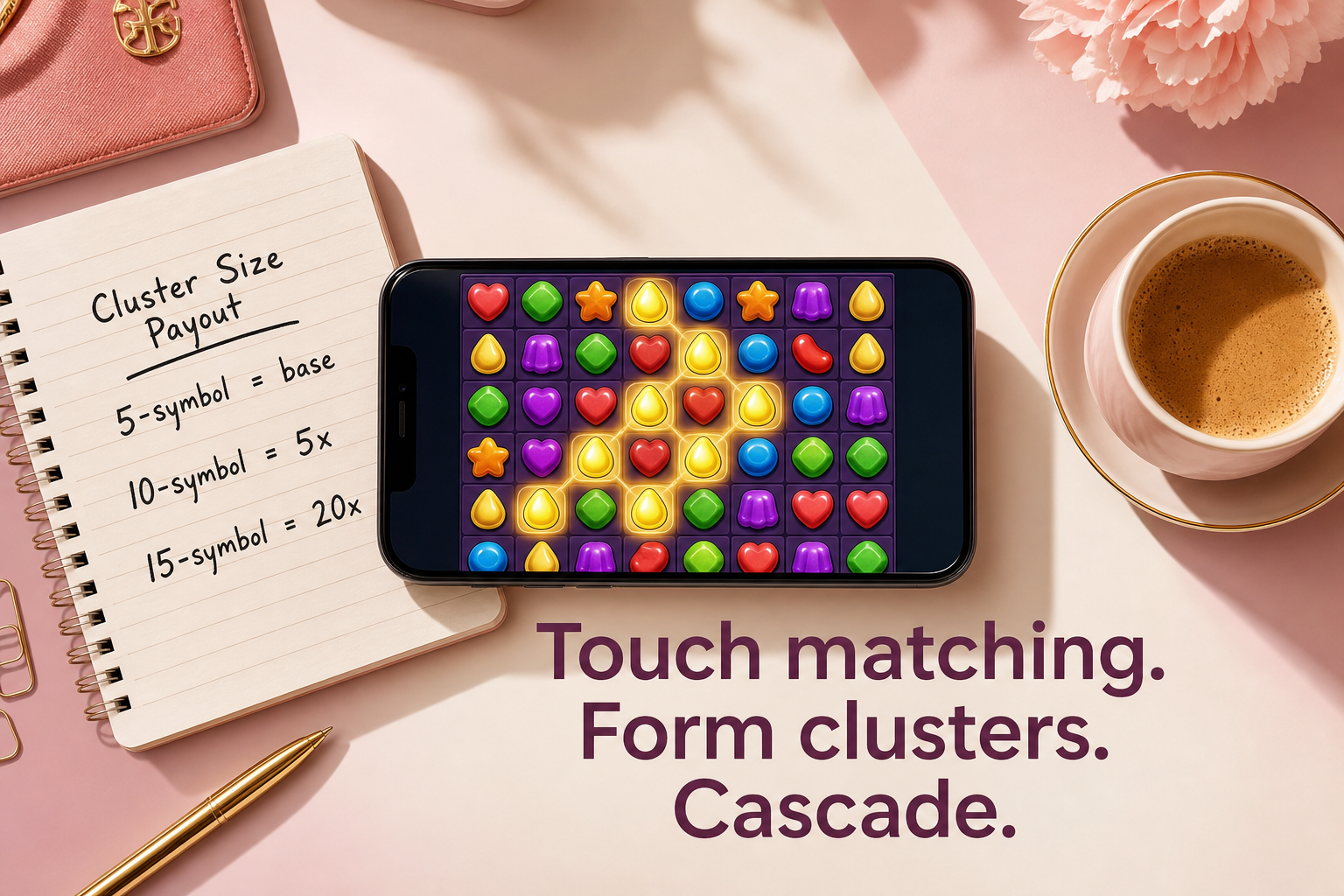
Cluster pays slot mechanics award wins when matching symbols form touching groups on a grid, usually horizontally or vertically. Instead of paylines, the game checks for qualifying clusters, often 5 or more symbols. Many cluster pays slots also use cascading wins, where winning symbols disappear and new ones drop in.
By Miles Carter, Sweeps Flow Editorial | Updated June 2026
Cluster pays slots can look like a candy-colored puzzle decided to become a slot game. Cute bonus. Complicated personality. The good news is that the core idea is simple once you stop looking for paylines and start looking for groups.
This guide explains how cluster pays slot mechanics work, why cascading wins matter, what RTP and variance mean here, and what to check before you spend time on one of these games. Terms apply. Game rules and availability can vary by operator, title, and state.
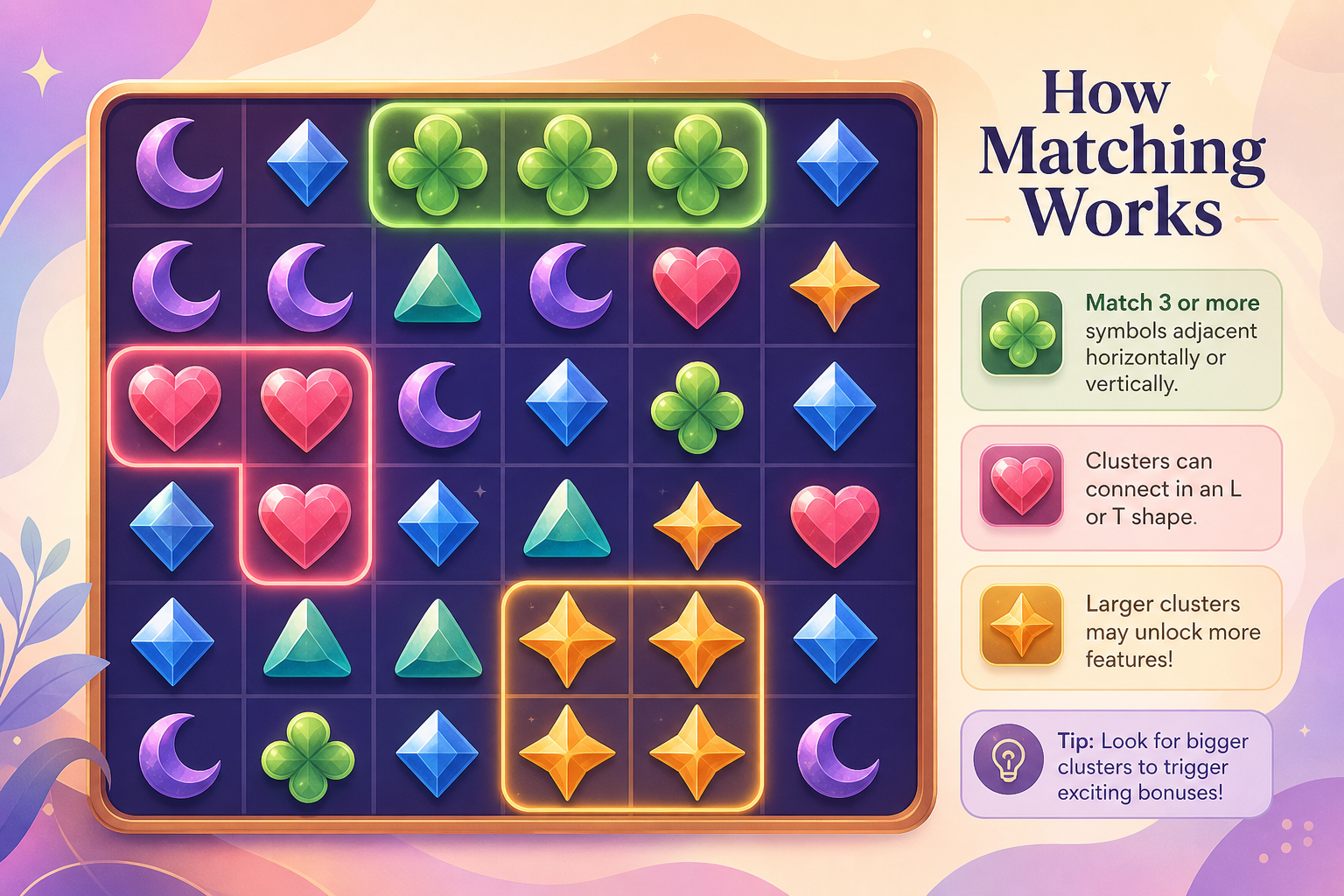
Quick Take
- Cluster pays is a slot mechanic, not one specific game.
- Wins come from groups of matching symbols that touch on the grid, usually side-to-side or up-and-down.
- Most cluster pays slots require at least 5 matching connected symbols, though some games use a higher minimum.
- Diagonal symbols usually do not count, but always check the game rules.
- Cascading wins are common. Winning clusters vanish, then new symbols drop in.
- Typical RTP sits in the standard slot range, often around 94% to 96.5%, depending on the title and operator settings.
- Variance is usually medium to high, so results can feel swingy in short sessions.
What are cluster pays slot mechanics?
Cluster pays slot mechanics replace traditional paylines with grid-based scoring. Instead of needing matching symbols on a fixed line, you need a group of matching symbols touching each other.
Think of it like spotting a little symbol neighborhood. If enough matching symbols are connected, the game counts that as a cluster and checks whether it qualifies for a win.
NetEnt introduced the mechanic with Aloha! Cluster Pays in 2017. The style became much more widely known after Pragmatic Play’s Sweet Bonanza series helped bring cluster games to a bigger audience.
How do cluster pays slots differ from paylines?
Traditional slots usually ask: did the right symbols land on a paying line? Cluster pays slots ask: did enough matching symbols connect anywhere on the grid?
The terms are doing the most, so here is the clean version.
| Mechanic | How wins are checked | What it feels like |
|---|---|---|
| Paylines | Matching symbols land on set lines across reels | Classic slot layout with highlighted lines |
| Ways to Win | Matching symbols land on adjacent reels, position matters less | More flexible than paylines but still reel-based |
| Cluster Pays | Matching symbols form connected groups on a grid | Puzzle-like, with groups lighting up across the board |
| Megaways | Reel height changes each spin, changing the number of possible ways | Very dynamic, often paired with cascades |
| Hold and Spin | Special symbols lock in place during respins | Feature-driven, often focused on bonus rounds |
How does cluster detection work?
After a spin, the game scans the grid for matching symbols that connect. In most cluster pays games, symbols connect horizontally and vertically. Diagonal connections usually do not count.
Here is the basic process:
- The game fills the grid with symbols.
- It scans for groups of matching symbols touching side-to-side or up-and-down.
- It checks whether each group meets the minimum cluster size.
- If the cluster qualifies, the game pays based on the symbol and cluster size.
- If cascades are active, winning symbols disappear and new ones drop in.
The exact rules live in the game info panel. That panel is not optional reading if you care about how the game actually pays. The fine print needs supervision.
What is a winning cluster?
A winning cluster is a connected group of matching symbols that meets the game’s minimum size. Many cluster pays slots use 5 or more matching symbols as the minimum. Some titles, especially with larger grids, may require 6, 8, or another number.
Cluster size matters. A 5-symbol cluster usually pays less than a 10-symbol cluster of the same symbol. Larger clusters can pay more because the paytable scales by symbol type and cluster size.
Always check the paytable before playing. Two games can both use cluster pays, but still have very different symbol values, minimums, bonus rules, and variance.
How do cascading wins work with cluster pays?
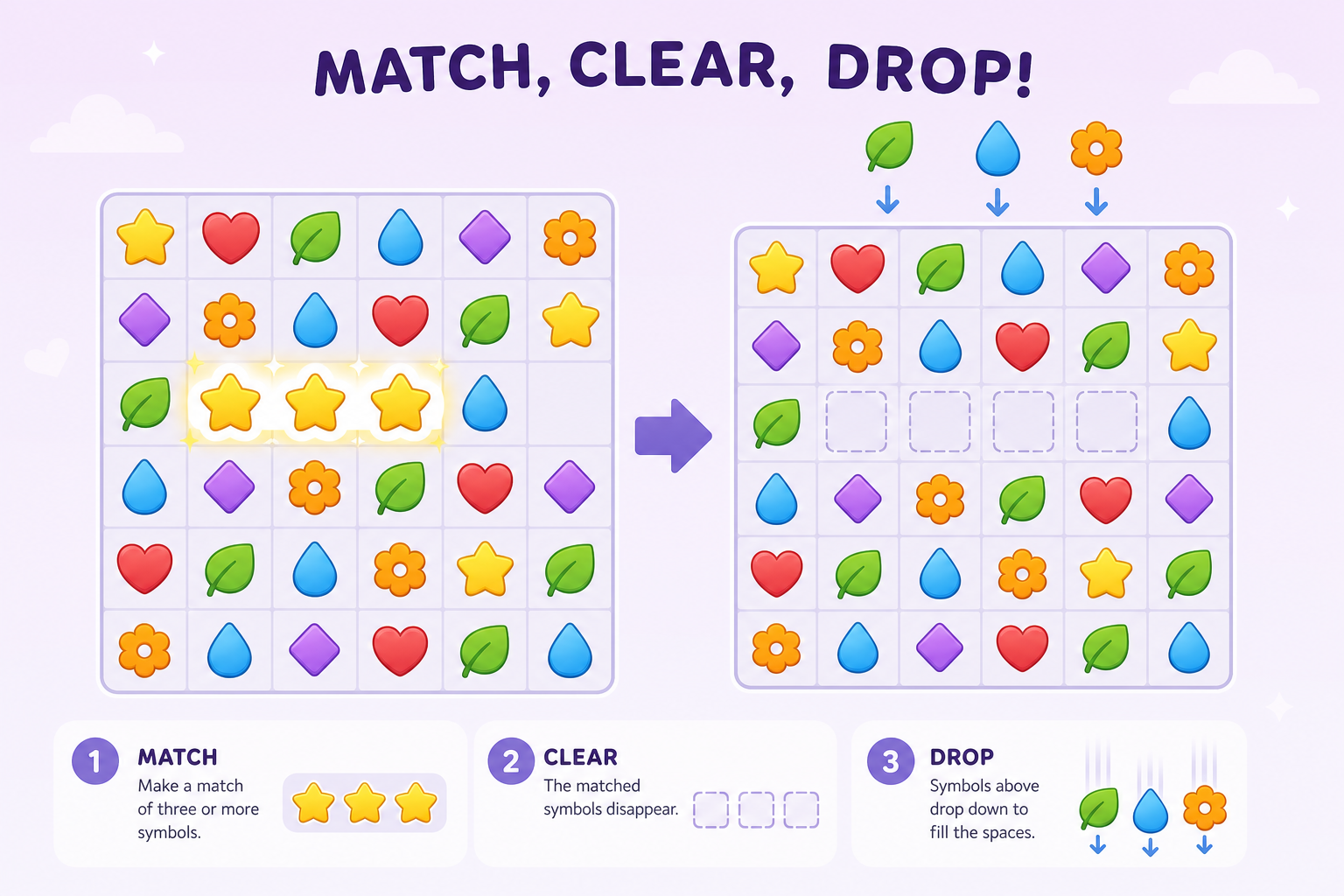
Cascading wins are a big part of why cluster pays games feel different. After a winning cluster lands, those winning symbols are removed. New symbols drop into the empty spaces. Then the game checks again for more clusters.
A single paid spin can include several cascades if new winning clusters keep forming. That chain continues until no new qualifying cluster appears.
Simple example:
- You spin and land a 6-symbol cluster.
- The game pays that cluster.
- Those 6 symbols disappear.
- New symbols drop into the grid.
- A new 5-symbol cluster forms and pays.
- The process repeats until no new cluster qualifies.
This is where the math starts acting suspicious. Not in a shady way, just in a “short sessions can swing hard” way.
What grid sizes do cluster pays slots use?
Cluster pays slots usually use grids instead of standard reel rows. Common layouts include 6x6, 7x7, and 8x8. Some smaller 5x5 versions exist too.
| Grid size | Total positions | Common cluster minimum | What to know |
|---|---|---|---|
| 5x5 | 25 | Often 5 symbols | Less common, smaller board |
| 6x6 | 36 | Often 5 symbols | Common for many cluster pays titles |
| 7x7 | 49 | Often 5 symbols | More room for larger clusters and cascades |
| 8x8 | 64 | Often higher, such as 8 symbols | Bigger grid, often paired with higher variance |
Larger grids create more space for big clusters and longer cascade chains, but that does not mean they are automatically a better fit. The minimum cluster size, paytable, modifiers, and variance label all matter.
What RTP and variance should players expect?
Cluster pays slot mechanics do not automatically mean a game has higher RTP than a payline slot. RTP depends on the title, studio, and operator configuration. Many cluster pays slots fall in the standard slot range, often around 94% to 96.5%. Some titles may sit outside that range, so check the game info panel.
Variance is usually medium to high. That means wins may be less steady, and a lot of the game’s math can be tied to cascades, bonus rounds, multipliers, or larger clusters.
Responsible play note: RTP is a long-term math estimate, not a promise for your session. Set a budget before you play, avoid chasing results, and take breaks when the game stops feeling fun.
What bonus features appear in cluster pays slots?
Many cluster pays slots add features on top of the basic cluster system. These can change the feel of the game a lot.
- Free spins with multipliers: Scatter symbols may trigger a free spins round where multipliers build during cascades.
- Enhanced grids: Some games change the grid, remove certain symbols, or add stronger modifiers during a bonus.
- Wild symbols: Wilds may help complete clusters, depending on the game rules.
- Multiplier symbols: Multipliers may boost cluster wins or total cascade wins.
- Collection features: Some games collect wilds or special symbols to trigger or shape a bonus.
Bonus buys may appear on some cluster pays titles, depending on the game and where you play. They can raise volatility and spend quickly, so read the rules and stick to your budget if you choose to use them.
Cluster pays slot mechanics checklist
Before you settle into a cluster pays game, do a quick receipt check. It takes one minute and can save you from playing a game that is not your style.
| Check this | Why it matters | Where to find it |
|---|---|---|
| Minimum cluster size | Tells you how many matching symbols are needed to win | Game rules or paytable |
| Adjacency rules | Confirms whether diagonal symbols count | Game rules |
| Published RTP | Shows the long-term return setting for that version | Info panel or operator game page |
| Variance label | Helps you understand how swingy the game may feel | Game info panel, studio page, or operator notes |
| Bonus rules | Explains scatters, free spins, multipliers, and bonus buys | Paytable and feature rules |
| Play limits | Keeps the session within your comfort zone | Your own budget before playing |
Are cluster pays slots better than payline slots?
Not automatically. Cluster pays slots are different, not magically stronger. Some players like them because the grid feels more active and the cascades add drama. Other players prefer classic paylines because the win path is easier to read.
If you like watching chains build and symbols drop, cluster pays may be a fun fit. If you prefer simple, steady-looking results, fixed paylines or lower-variance titles may feel calmer.
The protective takeaway: choose the game based on rules, RTP, variance, and your own budget. Not because the screen looks busy.
What to do next
- Open the game info panel before you play any cluster pays title.
- Check the minimum cluster size, RTP, variance, and bonus rules.
- Try a short session first instead of committing to long play right away.
- Set a spend limit and stop point before the first spin.
- Compare mechanics with our related guides on slot variance, bonus terms, and game features.
If you are new to sweepstakes casinos, start with the Sweeps Flow beginner guides and redemption guides before comparing individual operators. Access, promotions, and redemption rules can vary by state and platform. Terms apply.
Sweeps Flow Take
Cluster pays slot mechanics are easy to enjoy once you understand the rules. Look for touching groups, expect cascades, and remember that bigger grids and bonus features can make the ride more volatile. The mechanic is fun and visual, but it is still RNG slot math. Read the paytable, set your limits, and let the glitter stay recreational.
FAQs about cluster pays slot mechanics
What does cluster pays mean in slots?
Cluster pays means the game awards wins for groups of matching symbols that touch on a grid. Most games count horizontal and vertical connections. Many do not count diagonal connections, but the game rules should confirm that.
How many symbols do you need for a cluster win?
Many cluster pays slots require at least 5 matching connected symbols. Some games use a higher minimum, especially on larger grids. Always check the paytable because the minimum can vary by title.
Do cluster pays slots use paylines?
No, cluster pays slots usually do not use traditional paylines. They use grid-based scoring, where matching symbols must connect in a group instead of landing on a fixed line.
Are cluster pays slots high variance?
Many cluster pays slots are medium to high variance. Cascades, multipliers, and bonus rounds can make results feel uneven in short sessions. RTP does not predict what will happen in one session.
Are cluster pays slots available at sweepstakes casinos?
Some sweepstakes casinos may offer slot-style games with cluster or cascade mechanics, but game libraries vary. Check the current operator lobby, state access rules, and game terms before playing. No purchase is necessary to enter sweepstakes promotions where available, and Alternative Method Of Entry rules may apply.
Affiliate disclosure: Sweeps Flow may earn a commission if you use certain partner links, at no extra cost to you. Our editorial guidance stays focused on clear terms, safer play, and practical comparison.
Compliance note: Sweepstakes casino access, games, promotions, and redemption options can vary by state and operator. Terms apply. This article is for informational purposes only and is not legal advice.

Error